Construction Company Video: The 6 Videos That Win Bids and Hire Crews

A construction company video is only worth making if it does one of three jobs: helps you win a bid, helps you hire, or keeps your name in front of the owners and developers who will build next year. Most construction companies need six videos to cover all three: a company profile film, a project completion film, a pursuit (shortlist interview) video, a recruiting video, client testimonials, and a steady stream of weekly jobsite social. Everything else is nice to have.
I'm Bryson Valencia, and I run Social Cuts, a marketing agency in Austin that leads with video. Construction and the trades are one of the lanes we work, and the questions builders ask us are always the same: what should we make first, how do you film on a live site without slowing the job, and is this a one time project or a monthly thing? This guide answers all three, plus a short note on cost.
What a construction company video is actually for
Before you hire anyone or pick up a camera, name the person on the other side of the screen. For a commercial builder or a specialty trade, it's usually one of three people:
- The owner, developer, or owner's rep deciding who makes the shortlist and who wins the interview.
- The superintendent, project manager, or tradesperson deciding whether to leave their current company for yours.
- The broader market: architects, brokers, past clients, and subs who send you work when they remember you.
Each of the six videos below is built for one of those people. If a video can't name its viewer, it usually ends up as a nice reel that sits on the homepage and does nothing.
The 6 construction company videos worth making
Here's the short version before we go one by one:
| Video | Main viewer | Typical length | Where it lives |
|---|---|---|---|
| Company profile film | Owners, developers, recruits | 2 to 3 minutes | Homepage, proposals, LinkedIn |
| Project completion film | Owners in your sector | 60 to 120 seconds | Project pages, pursuits, YouTube |
| Pursuit (shortlist interview) video | The selection committee | 60 to 90 seconds | Sent ahead of or after the interview |
| Recruiting video | Supers, PMs, trades | 60 to 90 seconds, plus short cuts | Careers page, job posts, social |
| Client testimonial | Owners who are unsure | 30 to 90 seconds | Proposals, website, follow up emails |
| Weekly jobsite social | Everyone, every week | 15 to 60 seconds, vertical | LinkedIn, Instagram, YouTube Shorts |
Lengths are starting points, not rules. Cut to the story you actually have.
1. Company profile film
This is the construction company video most people picture: who you are, what you build, and why owners keep hiring you. It should run two to three minutes and sound like your people, not a narrator reading a brochure. Interview your president, a project leader, and someone from the field, and cover it with footage from your jobs, not stock.
A good profile film lasts years, so it's one of the few videos where a bigger one time production makes sense. Just make sure it says something specific. "Quality, safety, and integrity" is what every builder says. The sectors you build in, the way you run a job, and the people who will actually show up are what separate you.
2. Project completion film
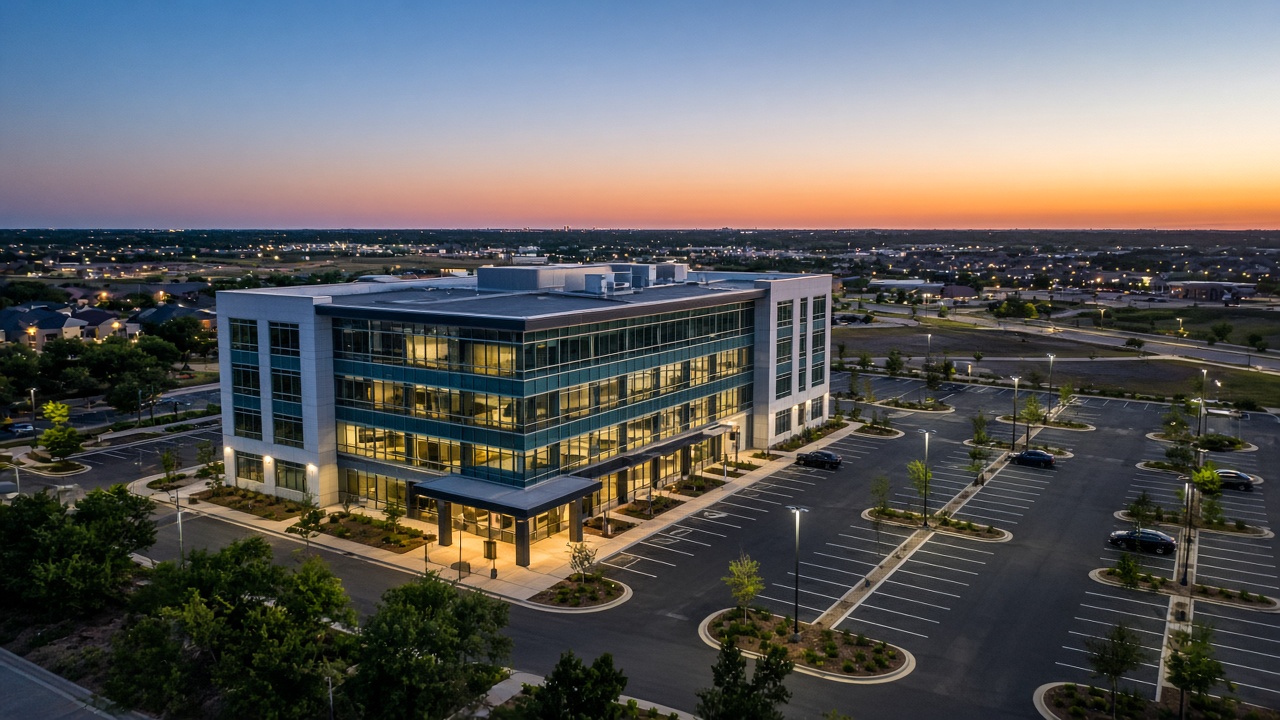
A project completion film tells the story of one building from the owner's side: what they needed, what was hard, and how it turned out. Drone at twilight, an interior walk, your project manager, and ideally the owner.
The trick is that the best completion films are planned at groundbreaking, not at turnover. If you want the steel going up, the first pour, and the topping out moment, someone has to be there for them.
3 and 4. Pursuit video and recruiting video
These two are closest to revenue and to your biggest constraint, hiring, so each gets its own section below.
5. Client testimonial
One owner or developer on camera saying why they would hire you again carries more weight than anything you can say about yourself. Keep it honest. Film the owner where the project happened, ask open questions, and let them use their own words. Don't script a quote and hand it to them.
Get written permission before you film and before you publish. Many owners have rules about what can be shown and who can speak for them.
6. Weekly jobsite social
This is the short vertical content that keeps you visible between big pieces: a pour at sunrise, a superintendent explaining a sequencing problem, a crew milestone, a safety moment done right. On its own each clip is small. Posted every week for a year, it becomes the record that proves you build what you say you build.
The pursuit interview video: where construction video wins work
If you build commercial work, you know the pattern. You submit qualifications, the owner shortlists a few firms, and then the job is often decided in a one hour interview. By that point everyone on the list is qualified. The owner is choosing the team they trust for the length of the job.
A pursuit video is built for that moment. It's short, specific to the project, and it puts the people who will run the job in front of the committee before the interview starts. Here's how I'd use it:
- Team introduction. The project executive, PM, and superintendent proposed for this job, each speaking for 15 to 20 seconds about how they would run it. Owners want to see the super, not just the people who present.
- Relevant proof. Short clips from your completion films on buildings like the one being bid, with the lessons that carry over.
- Approach to the hard part. If the site has a tight footprint, an occupied building, or a schedule problem, show the people who solved something like it walking through how they did it.
- Leave behind. A version the committee can share with the people who weren't in the room.
Two cautions. First, read the RFQ or RFP instructions. Some owners, especially public ones, limit what you can submit and how. If video isn't allowed in the submission, it may still work as a link in a follow up, or not at all, so ask the owner's contact before you assume. Second, keep each pursuit video tied to one project. A general reel with a new title card reads as exactly that.

Construction recruiting video: why it matters right now
Hiring is the problem almost every builder brings up. In the 2026 AGC and NCCER Workforce Survey, 87 percent of firms reported openings for hourly craft workers and 88 percent of firms with craft openings said those positions were as hard or harder to fill than a year earlier. Project managers and supervisors were hard to fill for 74 percent of firms with those openings. Associated Builders and Contractors estimates the industry needs to attract 349,000 net new workers in 2026.
A job post lists pay and requirements. A recruiting video answers what a good superintendent actually wants to know: who will I work for, what jobs will I be on, and do the people here like each other?
What I'd film for a construction recruiting video:
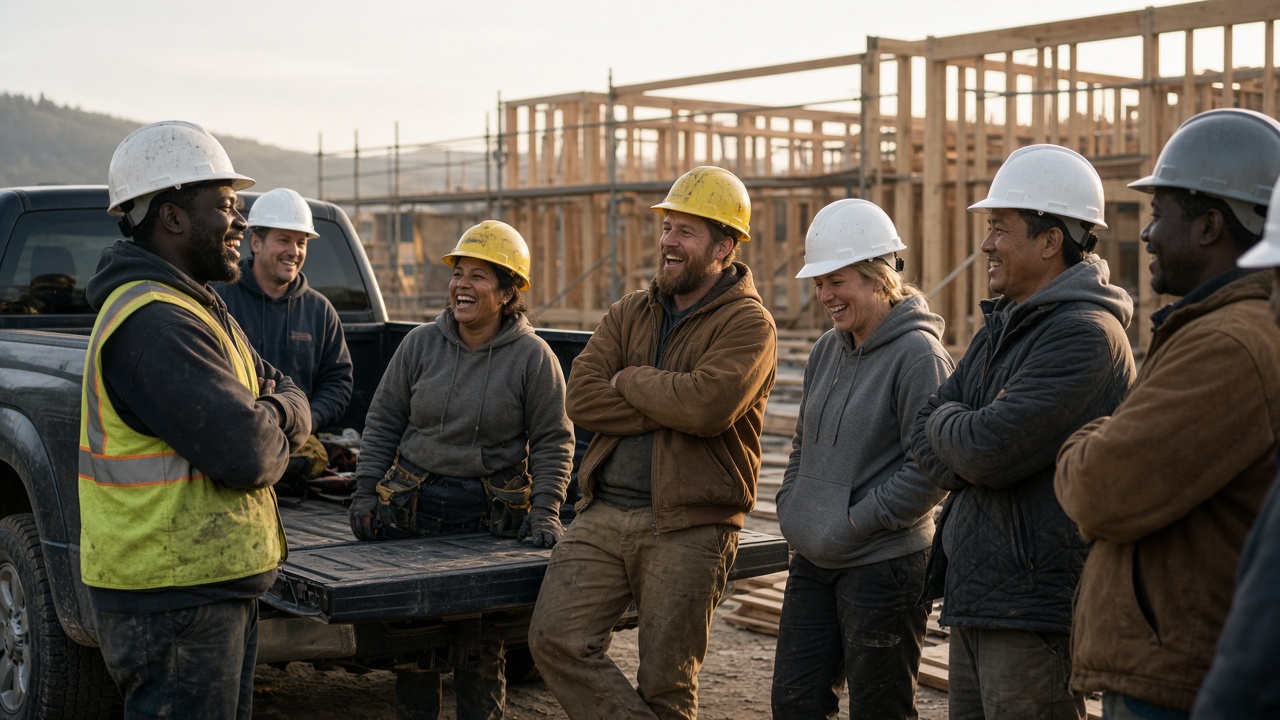
- A morning huddle, start to finish, so people can see how the day starts.
- Two or three people in different roles talking about why they stayed, in their own words.
- A foreman or super teaching an apprentice something on site.
- The trucks, tools, and jobs a new hire would actually be on.
Then cut it three ways: a 60 to 90 second careers page video, short vertical cuts for job posts and social, and a version for job fairs and school visits. Ask everyone on camera for written consent, and make sure anyone in the shot is in proper PPE. Recruits notice.
How to film on an active jobsite without slowing the job
The site comes first. A video crew that gets in the way of a crane pick or wanders under a load should be asked to leave. Here's how a well run jobsite shoot works.
Safety orientation and PPE
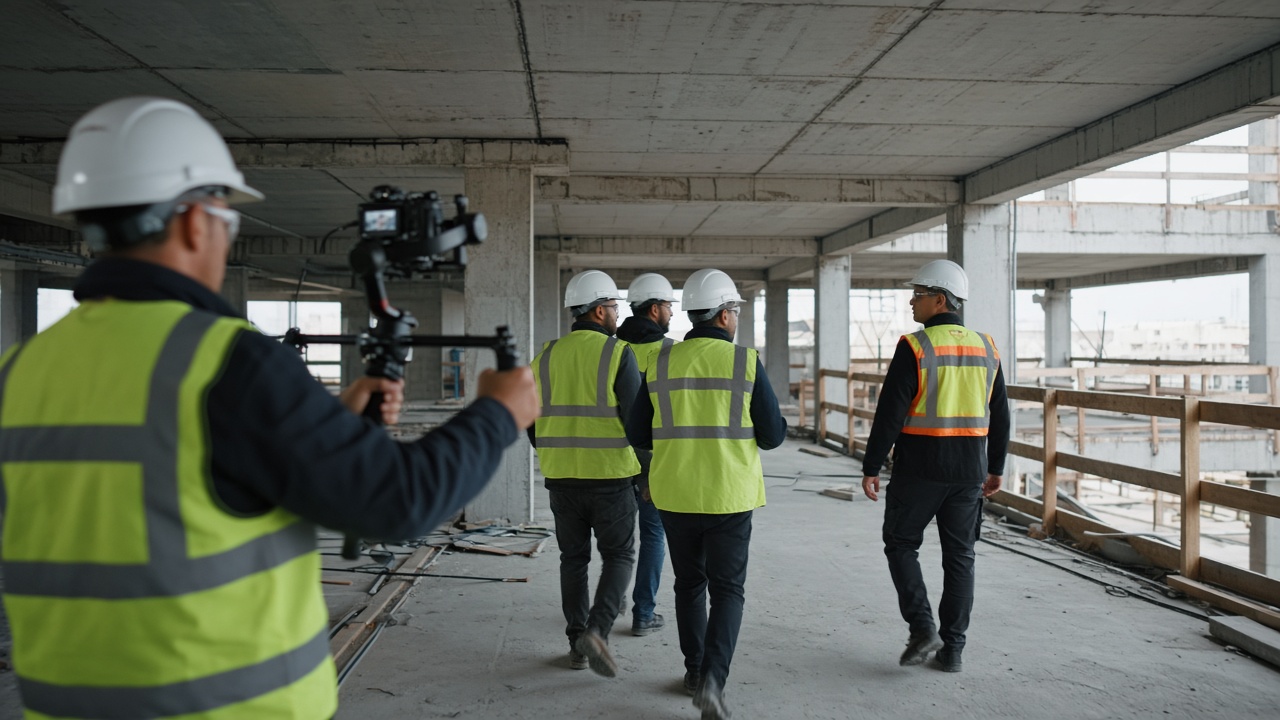
Everyone on the video crew should go through the site's safety orientation like any visitor or new worker. They should arrive in the PPE the site requires, which usually means a hard hat, high visibility vest, safety glasses, and work boots, plus anything specific to that job. The federal baseline for construction PPE is in OSHA's construction standards, 29 CFR 1926 Subpart E, but your site safety plan is what the crew should follow on the day.
Ask whoever is filming for a certificate of insurance before the shoot, since most general contractors require one from anyone working on site.
Superintendent sign off
The superintendent owns the site, so the shot list should go to them before the shoot day, not on the morning of. Walk it with them. They'll tell you which areas are off limits, when the crane is busy, where the good light is, and which crew is having a great week. Assign one person from your side to escort the video crew all day. That person is usually worth more than any piece of camera gear.
Permissions and people
- The owner. Many contracts limit what you can show of the building, the tenant, or the site before completion. Get written approval for what you plan to publish.
- Subcontractors. If a sub's crew or logo is prominent, let them know. Most are glad to be featured. Some have their own rules.
- Workers. Get signed consent from anyone who speaks on camera or is clearly featured. Let anyone who doesn't want to be filmed step out of the shot.
- Sensitive sites. Hospitals, schools, and secure or confidential facilities often have strict rules on photography. Ask before anyone brings a camera.
Drone rules
Drone footage is half of what makes construction video look the way it does, and it's also where people cut corners. In the US, anyone flying a drone for business under 55 pounds has to follow the FAA's Part 107 small drone rules. The basics worth knowing as the client:
- The pilot needs an FAA Remote Pilot Certificate, and the drone has to be registered. Ask to see both.
- Flights stay within visual line of sight and generally at or below 400 feet, with higher allowed only when the drone stays within 400 feet of a structure.
- Flying over people who aren't part of the operation is restricted unless the drone and flight meet the FAA's operations over people rules. On a busy site, that shapes when and where you fly.
- Controlled airspace near airports needs FAA authorization, often through LAANC. Parts of most large metros, including Austin, sit in controlled airspace, so check before you book a flight.
- Coordinate with the superintendent and crane operator. A drone and a tower crane should never be surprising each other.
Jobsite shoot day checklist
- Shot list approved by the superintendent at least a few days before.
- Owner approval in writing for anything you plan to publish.
- Certificate of insurance from the video crew on file.
- Site orientation scheduled for every crew member on arrival.
- PPE for everyone, including any job specific gear.
- One escort from your team assigned for the whole day.
- Crane picks, pours, and inspections on the schedule, with the shots planned around them.
- Drone pilot certificate, registration, and airspace authorization checked.
- Consent forms for anyone speaking on camera.
- Interviews booked in a quiet spot, usually the trailer or a finished room, away from saws and generators.
- Footage backed up before the crew leaves, with a plan for who edits what.
How one shoot day feeds a month of construction social
A well planned shoot day on a live project gives you far more than one video. The day just has to be built for it. Here's roughly how I'd structure one:
- Early morning: the huddle, crews arriving, the site waking up. This is recruiting footage and social footage at once.
- Mid morning: the superintendent walkthrough on a gimbal, explaining what's happening this week and why it's hard.
- Late morning and early afternoon: two or three short interviews with the PM, a foreman, and a tradesperson. Ask each the same handful of questions so you have options in the edit.
- Afternoon: detail shots of the work itself: connections, finishes, equipment, hands.
- Golden hour: drone and wide shots, if the airspace and site allow.
From a day like that, an editor can pull a run of weekly vertical clips, a progress update for the owner, recruiting cuts, and a bank of footage for the completion film later. How many finished posts you get depends on how many ideas you planned. Our guide to hiring a videographer for social media goes deeper on what one shoot day should produce and how to brief it.
Then post on a schedule, tie clips to real milestones, and keep the footage organized so the next pursuit team can find it fast.
When a monthly cadence beats one off construction videos
Not every construction company needs a monthly plan. A one off project makes sense when you need a single strong piece: a new profile film, a completion film for a flagship building, or a pursuit video for a specific interview.
A monthly cadence wins when any of these are true:
- You have active jobs worth documenting, so milestones are happening whether you film them or not.
- You're hiring all year, not just once.
- You pursue work regularly and want a library of footage ready for every interview.
- You want owners and recruits to see a steady record of your work, not one video every two years.
Once you're doing more than a couple of shoots a year, a cadence usually wins: planning gets reused, the crew learns your sites, and footage from one month feeds the pursuit video three months later. That's the model we run at Social Cuts: a content plan first, then shoots and edits that serve it every week.
What a construction company video costs, in short
I've already written a full breakdown of videographer rates and video production pricing, so here's just the short version. A solid professional shooter for social content runs about $1,000 to $1,500 a day for the shoot alone, and editing is a separate line. A full production day with a crew, which is closer to what a company profile film needs, can run $15,000 or more. Drone work, multiple sites, and travel add to either.
For construction specifically, the biggest cost driver is usually access, not cameras: how many sites, how many days, and how much coordination it takes to film safely around active work.
Who should make your construction company videos
You have three real options. A freelancer is a good fit for a single shoot when you already know exactly what you need and someone on your team can manage the plan and the edits. A video production company is a good fit for one polished film, like a profile film or a big completion piece.
A marketing agency that leads with video is the option when you want all six videos working together: the plan, the shoots, the edits, and the posting, on a monthly rhythm. That's where we sit. We're not selling a single video. We build the content engine, the same kind behind Ways2Well's 43M+ organic views in the last year, and point it at your bids and your hiring.
If you're in Central Texas and want to see how our video production in Austin fits into that kind of plan, start there. If you're also putting a founder or president on camera, our founder video guide covers that side, and if you host events or open houses, read how to hire an Austin event videographer. If you want an answer on whether we're a fit, the 60 second quiz will tell you.
FAQ
What should a construction company video include?
Real people from your company, real footage from your jobs, and one clear point for one viewer. For a profile film, that's who you are and what you build. For a project film, it's the owner's problem and how you solved it. Skip stock footage and generic claims about quality and safety.
How long should a construction company video be?
Short. Two to three minutes for a company profile film, 60 to 120 seconds for a project completion film, 60 to 90 seconds for a pursuit or recruiting video, and 15 to 60 seconds for social clips.
Can you film on an active construction site?
Yes, with the superintendent's approval, a site safety orientation, the right PPE, and a plan built around the work. Owners may also limit what can be published before the project is complete, so get that in writing first.
Do you need a license to fly a drone over a construction site?
For business use in the US, yes. The pilot needs an FAA Remote Pilot Certificate under Part 107, the drone has to be registered, and flights over people and in controlled airspace have extra rules. Ask your pilot to show the certificate and the airspace authorization before the shoot.
How much does a construction company video cost?
It depends on crew size, days, sites, and editing. Shoot only day rates for a solid professional run about $1,000 to $1,500, and a full production day with crew can run $15,000 or more. Our pricing guide covers every tier.
How do I promote my construction company on social media?
Post short, real clips from your jobs every week, put your people on camera, and tie posts to milestones. LinkedIn tends to reach owners and project leaders, while vertical video works on Instagram and YouTube Shorts.